Writing samples
MFA thesis-Echoes of water: they called her a witch
CONCLUSION
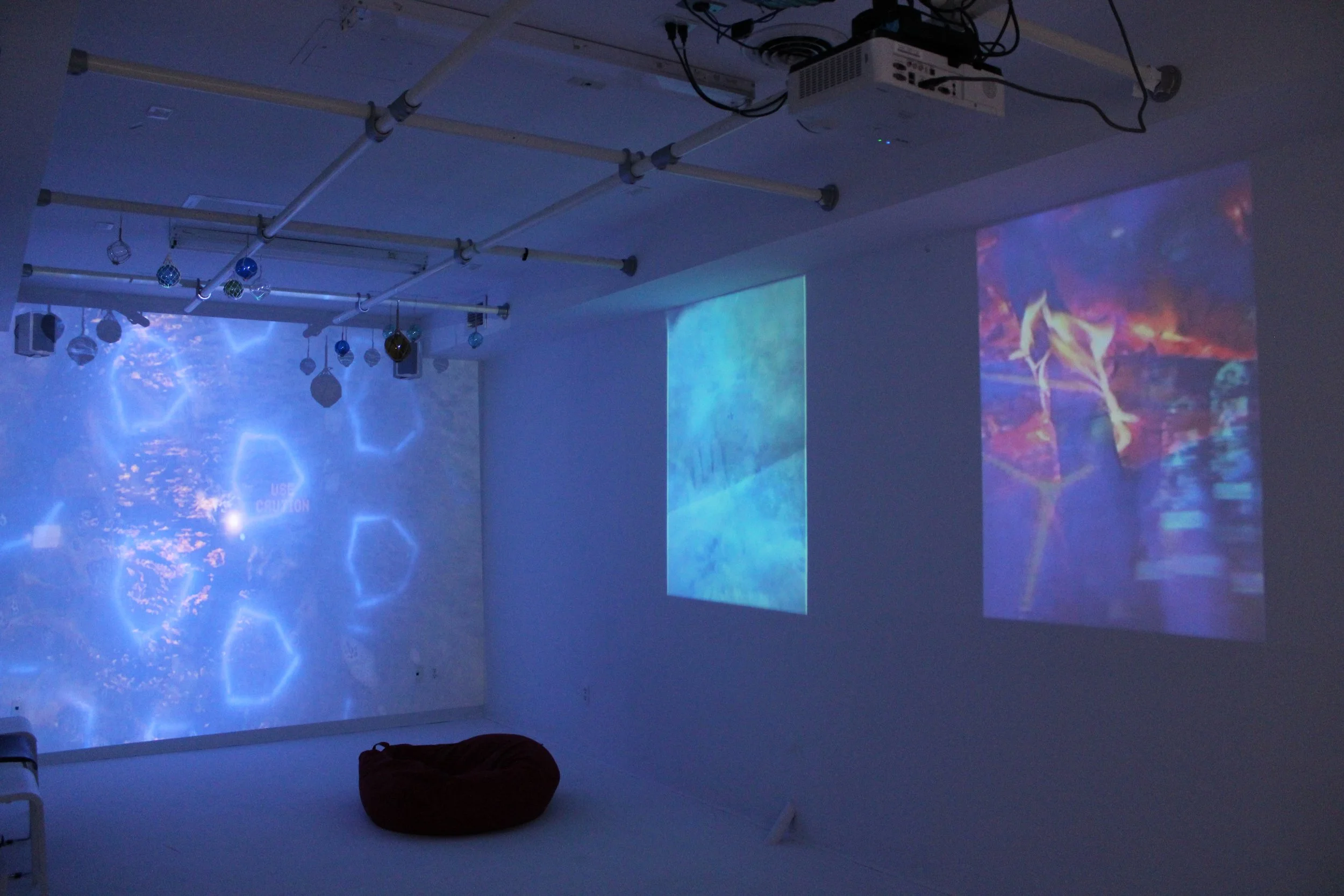
Everything returns to the circle. Time, snail shells, the water cycle, the self, the cycle of epigenetics in families. Glass witch balls, cyanotypes cut into imperfect circles, videos with orbs of light and layered over images of the total solar eclipse. In England I saw in a friend’s historic home the concentric circles that were carved into the beams of the house as signs of protection called witch marks. Circles and spirals, since our Ancestors first etched petroglyphs into stone, have historically symbolized a Portal.
I investigated my research questions through the research methodologies of mamatowisiwin, valuing dreams and storytelling as research as well as using psychic automatism. I applied these methodologies to my creative research practice in the studio, and I began to explore the complex question, how does water act as an inter-dimensional Portal to the Spirit World? I also looked at a variety of sources to explore a secondary question; how does water amplify or act as a boundary for Spirit? These sources included literature (Jasper), historical museums (Fairfield Museum and History Center), podcasts hosts and psychic mediums such as Tawney Lewis, as well as European theorists (Flusser). I was also guided by Blackfoot physicist Dr. Leroy Little Bear and Indigenous, Inuit and Métis Grandmothers (Anderson). These Indigenous sources were added for the distinct cultural cosmologies and teachings around water that they shared, they also helped to balance the written sources of my European settler Ancestors.
However, for much of the research that falls into the realm of the metaphysical, theories and more questions are often all I am left with. It is this ambiguity that intrigues me in exploring metaphysical and paranormal through arts-based research. In the absence of definitive answers on the nature of such enigmas as Portals and the Spirit World I let firsthand experiences of family and friends, as well as cultural beliefs act as lenses to explore these questions. I explored my research questions through my personal lens of experience, my disability and queer identity as well as through the lens of my European Ancestors and their many religious belief systems. The journey of exploring these questions inspired my use of familial and found materials, which reinforced the concept and form of my final thesis exhibit, Echoes of Water: They Called Her a Witch. In not being able to completely answer the research questions, I left room for the magic of the unknown.
In the absence of conclusive answers to my research questions, my metric for success shifted towards a focus in connecting personally with the viewers who came to my exhibit. I felt that my work was successful because of the rich conversations generated with viewers. I gave a casual tour of my work to two students who came to view my show, and I was left being fulfilled after a long conversation with them. The students were from Mexico and connected strongly to my use of marigolds in the cyanotype wall hangs and the cultural connections between the marigold and its ability to call in Spirits. They also connected strongly to my use of salt in the threshold, telling me that in their religion salt was highly symbolic and protective.
Other viewers focused on the more esoteric and mystical aspects of my work, including one man who talked to me at length about star seeds and the fifth dimension. While other viewers told me they had their own personal and cultural connections to the symbols that I was working with. One woman told me that she connected deeply to the spiral imagery, telling me that in her home country the graves often feature similar spiral imagery. Through my use of family interviews my viewer felt comfortable enough to confide in me about the recent loss of her Grandmother and she explained to me that her Grandmother’s grave had just been vandalized. We shared tears together as she asked me for my advice in making sure that her Grandmother was resting at peace. Sometimes I get the feeling that someone has crossed paths with me for a reason, so I could pass on a message or assist them, and I had a strong feeling that her Grandmother had sent her to me so I could comfort her and give her advice. She thanked me for reassuring her that her Grandmother was at peace and reminding her that she could still talk to her, even if she was now in the Spirit World. I gave her a glass of water to collect herself and after sharing a hug she told me that she was going to follow my advice and departed.
Water is a vital element necessary for life on our planet, it is present with us even before we are born, floating in the liquid of the amniotic sac. In Kim Anderson’s report, Grandmother Pauline describes water, “as a conduit in the womb, stating ‘you are in the womb for nine moons, which is the foundation for your life…everything within the surroundings of that water.’” (Anderson 8) Indeed, water is present as well when babies are born, we use water to bathe them and welcome them into this world.
When my parents and I first left the hospital four days after my birth, they took me immediately to Nauset, and to the Atlantic Ocean. The Ocean is my first primordial Mother, she will hold me and rock me in her waves long after my Mom passes away. My Mom was the first researcher in my life, and the first person who told me family stories as a child. The family stories shared with me often changed in shape and detail over the years, depending on who was telling them. As I grew older the conversation in the US around the colonial witchcraft hysteria began to shift from the occult references and commercialization to a more nuanced discussion around the reasons that these alleged witches were accused. Witchcraft accusations were a way to reinforce power structures and to uphold colonialism, Christianity and the patriarchy.
My Ancestors were called witches, and maybe I’m a witch too. The tale of Mary Staples and her family was constantly being told and re-told by my Mom and myself over the years. It is a story that I have carried with me, in each of the places that I have lived and studied. In researching my paternal family since 2020 I have found even more Ancestors who were called witches. They were believed to be witches because they were outspoken women, midwives, healers, and widows. They disregarded societal and gender norms and in some cases were accused of learning about magic or medicine from Indigenous people. Calling a woman a witch was a way to control her and often a way to kill her if you didn’t like how she dressed or what she had to say. I believe that in some way, these witches dunked in the water of my hometown must leave some of that memory forever in those water molecules.
Through my investigations about the idea of water acting as an inter-dimensional Portal, I have come to hypothesize that perhaps saltwater acts as a sort of battery, using the natural electricity that powers our bodies. Water seems to act as an amplifier; a belief shared across different people and cultures that I researched through literature, podcasts and their firsthand experiences. Since our bodies are primarily composed of water, I infer that people may also act as amplifiers of the Spirit World. We can channel our Ancestors, and practice speaking with them and we can learn how to listen to their wisdom. As Little Bear said, “It is the energy waves that know…It is not you that knows. You know things because you are made up of energy waves...” (Hill 6) It is not me that knows, the truth about my questions flows on energy waves from the Spirit World and the answers are not yet for me to have. They come in the fleeting moments when my unconscious mind is in control, when I am in a trance, drawing or during my dreams and visions. As soon as I return to my conscious mind, I am left again only with my theories and the facts of my personal experiences.
My personal experiences with Spirits guided my research as did the stories shared by family and friends in interviews. I explored the history of Spiritualism and that movement’s insight on the connections between women and the Spirit World, as well as providing theories on psychic abilities. Eve Olsen, my Grandparent’s psychic friend was a Spiritualist, and she would give my family members direct messages from their Ancestors who had passed. My Mom often repeated these stories about Eve to me while I was growing up, shared around the bonfire in Nauset. The imagery and audio soundtracks of fire also evoke an Ancestral connection; humans are still just as hypnotized watching the flames. Fire can sustain or create life, but it is also an element that can be a destructive force, that must be respected as fire can also take life away.
Circles were an important visual metaphor for Portals and the non-linear view of time. The shape also symbolized celestial bodies, the water cycle, the self, epigenetics and the way that stories move in circles (Wilson). I do believe, after the culmination of my research, that Portals may possibly be an explanation for the connection between disparate paranormal activity like Spirits, cryptids and aliens. I have come to 62 believe through personal and firsthand experiences that water may act as an amplifier for Portals, but that Oceans and mountains may also act as physically derived boundary for Spirit. The importance of water as a boundary for the Spirit World was repeated to me by my 奶奶 in the story she told me about protecting my cousin Alex from his father’s angry Ancestors. I can’t claim to have the answers, no one does. The question of the Spirit World and discussions of Portals are topics that are enduring mysteries for the human race. In pondering these large and complex questions, I am connected to my Ancestors who also laid back on the ground at night and gazed at the stars, wondering if there was anything else out there.
I felt that I had succeeded with my research, even if I wasn’t left with clear and definitive answers. My success was felt through the involvement of my family members in my research, and the validation I received from everyone that I interviewed that my research project and efforts to build a family archive were very important. My methodologies also proved successful in developing deeper connections to my Ancestors. Two years ago, my Dad’s side of the family tree still seemed unfamiliar to me, I had names, dates and records but the people they were referring to hadn’t come alive to me yet.
I often wondered about my family members and Ancestors that I didn’t remember or had never met. Would my Great-Grandmother, Elizabeth “Betty” Ann, have liked me? Would we have gotten along? In my interview with Aunt Tanya, she told me that Nana (Betty) had taught Tanya to knit, crochet, sew and make quilts and they bonded through these activities. I imagined how much I would have enjoyed designing a quilt with my Great-Grandma and choosing the fabrics and patterns with her. In my interview with my Grandpa Tom he told me that he thought if his Mom and I could meet, “Oh you would get along really well together!” Today, I feel deeper familiarity with my Milne and Gagné Ancestors. I found what might be the only photo of me and my Great-Grandma Betty, she holds me beaming in her beach chair on the shores of the Atlantic Ocean. I knew her once and through the conduit of water she can communicate with me and pay me visits in Spirit form. As Aunt Tanya said during our interview, “I know Nana is protecting me, I feel her with me all the time.” I hope that I too, will begin to feel my Great-Grandma’s presence.
There are many cultures around the world that believe that water holds memory. The greatest disrespect we can do to both water and to our Ancestors, past, present and future, is to pollute water, to fill it with microplastics, oil or radiation. Clean drinking water is an inherent right that an increasing number of global citizens lack, “freshwater—what we need to drink and irrigate our farms—is only 3% of the world’s water.” (Gordon) A new technology, Artificial Intelligence (AI), is the latest threat to our water sources. I only believe in using this technology, AI, for medical and scientific advancement, with proper human oversight and regulation. It might unlock new pharmaceutical treatments for our family’s genetic curses. As an artist and writer however, I am extremely against the idea of generative AI.
Generative AI steals living artist’s work, even down to their signatures. It charges for its theft, and the “art” or “writing” it creates is darkly soulless. You need a soul to create. I now believe that you need to be made of water, to have a soul. Meanwhile AI “data centers [are] using cooling towers and air mechanisms to dissipate heat.” (Gordon) There is an increasingly large need for water and energy to power these AI centers. This lazy use of generative AI for everyday tasks like writing emails has a dire environmental cost. Artificial Intelligence is one of the greatest growing threats to water and our environment.
On the East Coast, they didn’t burn witches at the stake with fire. They hung them in wooden gallows, pressed them with stones and drowned them in water. Water remembers each of its reincarnations through its cycle. Water gives life, and it takes it away. In birth and in death, the first and last task is always bathing the body that lies on the threshold between our world and the Spirit World.
Water is our sacred Portal, the unbroken link between all living beings and Mother Earth. Her heartbeat is the circling storms with water in all of its incantations; we cannot exist without our Mother. I had a strange dream the other night, I was falling through the blackness, outside of my body when I heard familiar voices singing. Tthe song was a foreign language, one that I had spoken long ago when I was a child, but I had almost forgotten.
I followed the voices to the edge of the Ocean where all my Ancestors called to me. All the ones I dreamed of, the ones who passed long before me, even those whose names I had forgotten. I saw my Ancestors there that had been lost in the living memory of our family; and they embraced me for finding their photos, and for recovering their names. They told me that they had always sung to me while I slept, sending me memories and protecting me. I saw my loved ones there, the ones I had known but who passed before me; I saw my Grandparents, Great-Grandparents and all of my cousins; those whose voices I haven’t heard for years, I had almost forgotten the sound.
I saw the future Ancestors too, the ones that I dream of. They can take the work that I have started and carry 65 it further, until time is no longer a straight line, but swirls again into a spiral. Together, all of my Ancestors sang with me, and the strange ancient wordsrose up from my chest, bursting through my throat with a divine melody.
The Portal lies at the bottom of the lake, but to get there, you’ll have to drown.
The Portal lies at the bottom of the lake, but to get there, you’ll have to drown.
The Portal lies at the bottom of the lake, but to get there you’ll have to drown.
But to get there, you’ll have to drown.
To get there, you’ll have to drown.
To get there, you’ll have to drown.
Art review-The polar night, the midnight sun: a land of contrasts
Arctic Highways was on view at the American Swedish Institute (Minnesota) from February 3-May 26, 2024. It exhibited the works of Sámi artists: Tomas Colbengtson, Dan Jåma, Laila Susanna Kuhmunen, Britta Marakatt-Labba and Máret Ánne Sara. It also included photographs by Maureen Gruben (Inuvialuk). Other related artists and duodjars include: Anna-Stina Svakko and Anders Sunna (both Sámi).
Borders between countries are invisible, artificial lines drawn on the maps of colonizers. Borders between groups of people are just as invisible, yet equally real. The exhibition Arctic Highways dealt with the question of borders (between lands and people) and the ever-present issue of climate change. Many of the works directly or indirectly deal with the unique Arctic environment. I will delve into the art born from the Áltá crisis that inspired both a new word and a new recognition of Sámi issues among global Indigenous people. I explore the context of this new word (dáidda) as well as how it differs from duodji. The duodjars in the exhibition keep alive the tradition of duodji and the closely linked Sámi epistemologies, it is also a powerful act of self- recognition and visual sovereignty. Despite the artists in this exhibition coming from five different “countries” they are all one: Indigenous people of the Arctic Circle. These artists use cultural history and language to reconnect or strengthen their cultural identities that have been chipped away at by assimilation and colonization.
In 2016 a movement erupted on the Standing Rock Indian Reservation in North Dakota. A spark was lit when the land defenders first started to protest the Dakota Access Pipeline; that spark grew into a fire that spread across the world. For the Sámi people, this conflict felt very familiar, and it brought the memory back for those who had been alive during the Áltá1 conflict of 1979. The Áltá protest movement created not only visibility for Sámi issues in Scandinavia but led to a larger visibility among global Indigenous people.
This visibility was the beginning of the Sámi reawakening: a cultural and historical revitalization where self-determination and Indigenous Sovereignty were expressed through direct action, art, writing and music. As Harald Gaski explains in an interview, “another important factor...the attention that the Áltá protests received globally, was the international organization of indigenous peoples initiated in the 1970s” (Kuhn 2020, 25). Before the Áltá conflict, it was said that “many Norwegians hardly knew that Sámi existed outside of museums; they had no concept of us as living people” (Kuhn 2020, 47). The impact of this conflict cannot be overstated regarding self- recognition, and a wider global recognition of the Sámi among other Indigenous people. Even though the dam was built, the Áltá movement was still considered a success because of how it brought Sámi issues not just to the table of Norwegians, but to people around the world.
The Indigenous people of Turtle Island and those of Sápmi have many shared struggles, but the history of those struggles have had significant differences. As Øyvind Ravna explains saying “in North America, there is a lot of talk about broken treaties. In Sápmi, we never had any treaties” (Kuhn 2020, 89). Despite these differences, there are many shared struggles between the Sámi people and the First Nations of Turtle Island. After the Áltá conflict, Sámi land rights found themselves firmly on the map, and efforts to strengthen ties between the Sámi and other Indigenous Nations came to the forefront.
1 The conflict in Áltá was also an issue of protecting water and protecting the rights and traditions of Indigenous people. The Áltá river, which is both sacred and vital for the livelihood of the Sámi people of that area, was damaged irrevocably by the construction of a hydro-electric dam
Øyyind describes contemporary efforts for the Sámi to join with other Nations in solidarity, “several Sámi delegations traveled to the Standing Rock Indian Reservation in 2016 to join the Dakota Pipeline protests” (Kuhn 2020, 38). My last conversation with my Grandfather was about Standing Rock: he told me how much it moved him to see Indigenous people from around the world coming together to stand in solidarity. Grandpa told me that this was just the beginning, that he felt the tides were turning. On the day the camp at Standing Rock was forcibly cleared out, my Grandfather dropped dead in his home. A few days later my mother sent me his will: he asked to have his cremated remains spread in Lake of the Isles. Even as an old man he held this truth, that water is life.
Britta Marakatt-Labba is a widely recognized Sámi artist, thanks in part to her involvement in the Máze Artist Collective. It was narrative embroidered tapestries that made her so famous during the Áltá conflict of 1979. Marakatt-Labba creates her embroidery, on a panoramic strip of fabric, “her images are miniature worlds created with needle and thread“(Arctic Highways 2023). Marakatt-Labba’s tapestry Urgröpt 11 (Hollowed out) depicts sparse landscapes in primary colors. This tapestry explores the creation of a hydro-electric dam which greatly disrupted the millennia long tradition of reindeer husbandry in this area of Sápmi. The antlers of reindeer form an organic pattern against the cool blue fabric. Marakatt-Labba says of her embroidered tapestries that Sámi culture was rich in oral stories, however, “I realized that we Sámi lack stories in the form of pictures….my pictures contain scenes from everyday life, tales from Sámi mythology, political reflections and tales about Sámi culture and history” (Mötesplats Granö 2022). Fellow Máze participant, Synnøve Persen, explains in the book Liberating Sápmi3 that, “we were young Sámi artists…we wanted to return to Sápmi and found an arts collective. That was in 1978. A year later, the Áltá conflict came to a head. Máze played an important role, because…the entire community would have been flooded” (Kuhn 2020, 48-9). Máze has left its mark in history, and it is difficult to talk about the larger Áltá conflict without invoking this art collective which intertwined art with political activism.
Without the art produced at this time, I believe that Áltá would not have had the same impact. Jolene Rickard writes about visual sovereignty in the work, Diversifying Indigenous Sovereignty and the Reception of Indigenous Art. Rickard explains the concept of visual sovereignty saying, “eventually I came to articulate that among sovereignty’s many interpretations, ‘visual sovereignty’ is one of the most dominant expression of self-determination” (Rickard 2017, 3). Through this visual sovereignty expressed in the Máze group’s art, the larger international community began to pay attention to what was happening in Sápmi. Art is a powerful tool both in spreading a message and in proudly expressing your culture and history. Marakatt-Labba’s latest sculpture on view with Arctic Highways titled Urmoder (Primordial Mother) is small in scale, and the base is a triangular stone. Perched upon it, made of bronze, is a simple profile of a person wearing a larger horned hat, which evokes the older traditional Sámi woman’s hat that was popular in Northern Sápmi before Christianization.
3 The book is a series of interviews published in 2020 between Sámi activists and author Gabriel Kuhn
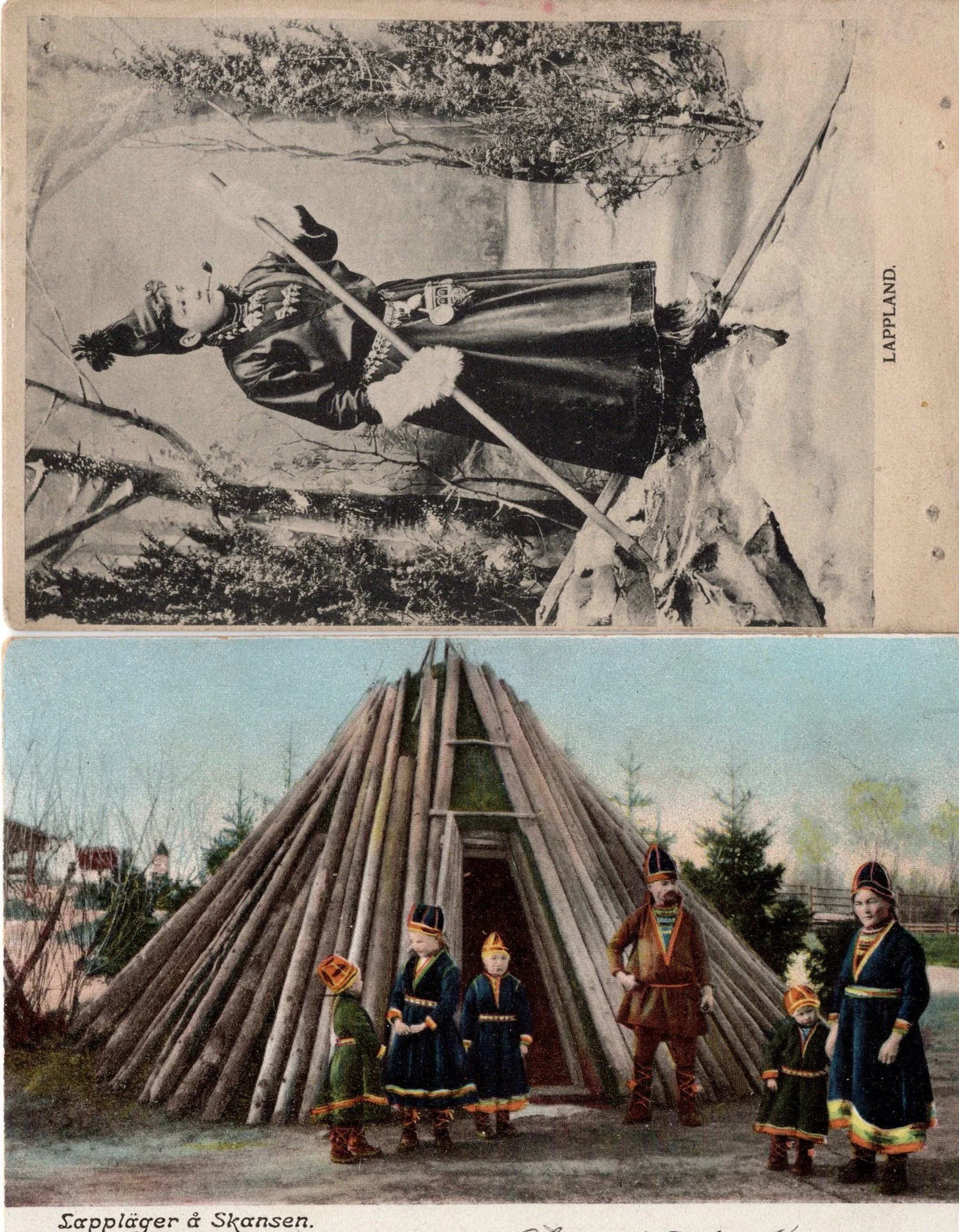
The hat, specifically called a lájogáhpir4, is often called the horn hat. There has been a movement in the recent decade to reclaim the lájogáhpir and master duodjars have begun to make this style of hat again. Urmoder is an example of the power of art to reclaim traditions that were destroyed during colonization, in the reclamation of the lájogáhpir modern duodjars exercise their sovereignty and engage in the process of Indigenizing. Harald Gaski writes, “even during periods of the most aggressive colonization and assimilation, as well as during the Christianization by force that took place…the Sámi turned to their own cultural expressions as an internal defense against external pressure” (Kuhn 2020, 40). This internal cultural defense is exactly what Marakatt-Labba evoked with her Urmoder sculpture, a relic against external colonizing pressure. Another contemporary female artist who creates political art is Máret Ánne Sara.
Máret Ánne Sara is perhaps one of the best-known contemporary Sámi artists on the globe, despite being born in 1983. Sara is both an artist and author, she was raised in Guovdageaidnu (Norwegian side of Sápmi) in a reindeer-herding family, which has greatly influenced her art which falls into the category of activist art. She crafted Moder Jord I (Earth I) using a “globe and scooter spring” (Fullerton 2022). It was created in 2015 and depicts a šiella5, perhaps better known by the Norwegian name, komsekule, meaning silver amulet. The šiella is a powerful, historic Sámi symbol, one that even my younger cousins immediately recognized as soon as they entered the gallery, crying out gleefully, “look Jules, a šiella!” I interpreted the šiella as a prayer of protection for this sick planet. Sara’s best known art piece is Pile o’ Sápmi which was originally shown at Documenta 14 (Kassel) in 2017.
4 The hat was made illegal by Christian missionaries because they said it evoked the devil’s horn
5 The šiella predates the colonizing countries that would eventually corrupt Sápmi, and dates to at least the Viking age. The custom with a šiella is to keep it on a baby’s cradleboard for protection against sickness and evil
In 2022 Sara was one of three Sámi artists who transformed the Nordic Pavilion at the Venice Biennale, as a strong expression of Indigenizing and expressing sovereignty: it was renamed the Sámi Pavilion for the duration of the show. This small renaming was a symbolic reclamation by the original stewards of the land. Pile o’ Sápmi is not just an art piece for Sara, it is a deeply personal act of protest on behalf of her brother, Jovsset Ánte Sara. As Øyvind Ravna explains during their interview for Liberating Sápmi, “Jovsset Ánte Sara’s case is quite extreme. He is a young reindeer herder who doesn’t have a huge herd yet. If he culls the reindeer requested by the authorities, he’d be down to seventy-five animals. But you can’t make a living off seventy-five reindeer” (Kuhn 2020, 88). Jovsset’s court case has been ongoing for several years now, rising from the Norwegian Supreme Court all the way to the United Nations, however no justice has been found yet for this fledging reindeer herder.
In February 2016, the original iteration was “an installation of 200 reindeer heads outside the Inner Finnmark District Court” (Sara 2017) and it was an act of visceral protest as much as it was a piece of art. Sara’s ongoing interdisciplinary exploration of Pile o’ Sápmi has greatly raised attention to her brother’s court case and to the larger issue of infringement of Sámi rights by the colonizing governments. Jovsset’s case has now acquired international attention.
Sara has a text that accompanies one of her paintings created as part of Pile o’ Sápmi, the text reads, “officially, the Norwegian government claims that the Sámi reindeer herders had-and exercised-self-determination in the reduction process. This so-called ‘inner self- determination’ came into effect only after the government had set the total number of animals to be slaughtered” (Kuhn 2020, 91). For a siida to agree to a decision on herd culling, there must be a unanimous vote, something that is quite hard to come by. This also places the blame on the individual siida instead of where it rightfully belongs, with the Norwegian Government. After centuries of attempting to destroy traditional Sámi livelihood and culture, Norway plays the role of instigator and creates a situation of divide and conquer. When a colonizer can pit citizens of a minority group against each other, the focus fades from fighting the colonizer to fighting each other.
As Pile o’ Sápmi grows and changes over time, this stark sculpture of reindeer skulls now references the Sámi flag. The visceral quality of the stark skulls brings the reality of the culling case to light. Over the years since its inception, the number of skulls increased and now measures 400. As Jovsset’s case goes from court to court6 Norway, decided and “officially stated that the reindeer herders are ‘incapable’ of self- determination and the government formally legitimized an overtaking of the process of setting a forced reduction model…the process was effectively a form of collective punishment” (Kuhn 2020, 92). Clearly, this is an egregious example of colonization occurring in real time, and the idea that the Sámi people are “incapable” of self- determination is a bold lie peddled by colonizers.
The use of natural materials in Sara’s work is not just an aesthetic statement, as Joar Nango (Sámi artist and architect) explains in an interview for Pinup Magazine. The use of available materials is misinterpreted by the larger ‘Art World’, as Joar says, “I think that many of those elements are for many people, very exotic. Because for us up here, this is not exotic at all. You know, like using reindeer skin to sit on…it’s a super sustainable way of using all the parts of the animal. There’s no oil being pulled out of the ground...it’s never even entering a monetary system” (Zeiger 2019). For Sara, utilizing reindeer skulls in her art is a natural choice, and reindeer when they are slaughtered have every part used, nothing is wasted. Anders Sunna is another political artist, but he differs from Sara in his medium and materials.
6 At immeasurable expense to Jovsset, who will undoubtedly be paying fines and court fees for the rest of his natural life
Anders Sunna is a painter, and he often depicts police and government figures as ghostly silhouettes, lacking faces and emotions. In the painting from 2014 Area Infected, Sunna depicts “a forest standoff, police cars and reindeer against an ominous red dripping sky” (Fullerton 2022). Sunna’s paintings are an amalgamation of several scenes combined into one composition, engaging the viewer on this journey through time and space alongside Sunna and his family. He says of this painting, “when you grow up with a conflict and are in the middle of it, it becomes your life and everyday life” (Larkindurey 2024). It is impossible to separate art from Sámi life, just as it is impossible to separate activism from Sámi life. Anders Sunna is listed in Liberating Sápmi as being part of “…a new generation of Sámi artists who are unabashedly political…visual artists Anders Sunna, Máret Ánne Sara, and the Suohpanterror collective. However, it is difficult…to distinguish ‘political’ from ‘nonpolitical’ artists in Sápmi. Arts and politics are so closely intertwined that ‘artivism’ has become a bon mot” (Kuhn 2020, 37). For Sámi people, their own existence is political, and even wearing traditional clothing (kolt) is a political act. When your whole life is politicized, it is difficult to separate activism from daily activities. This politicization of daily life is something that is shared by Indigenous people across the globe, and this links the struggle of Sápmi with that of Turtle Island.
Short story excerpt: The cold plague
Thousands of miles away from the sandy spit of Cape Cod, something began bubbling, deep within the earth. The bubbling grew more violent and hungry, finally giving way to a major explosion of Mount Tambora in April 1815. The eruption was the largest volcano explosion in recorded human history, coming to a zenith on April 10, however the eruptions continued on a smaller scale for three years. The ash from the volcano polluted the air around the entire globe, lowering temperatures and being the impetus for the “Year without a Summer” in 1816. The people of Outer Cape Cod had never heard of this volcano, they probably couldn’t even place the mountain on a map, but the effects were felt regardless.
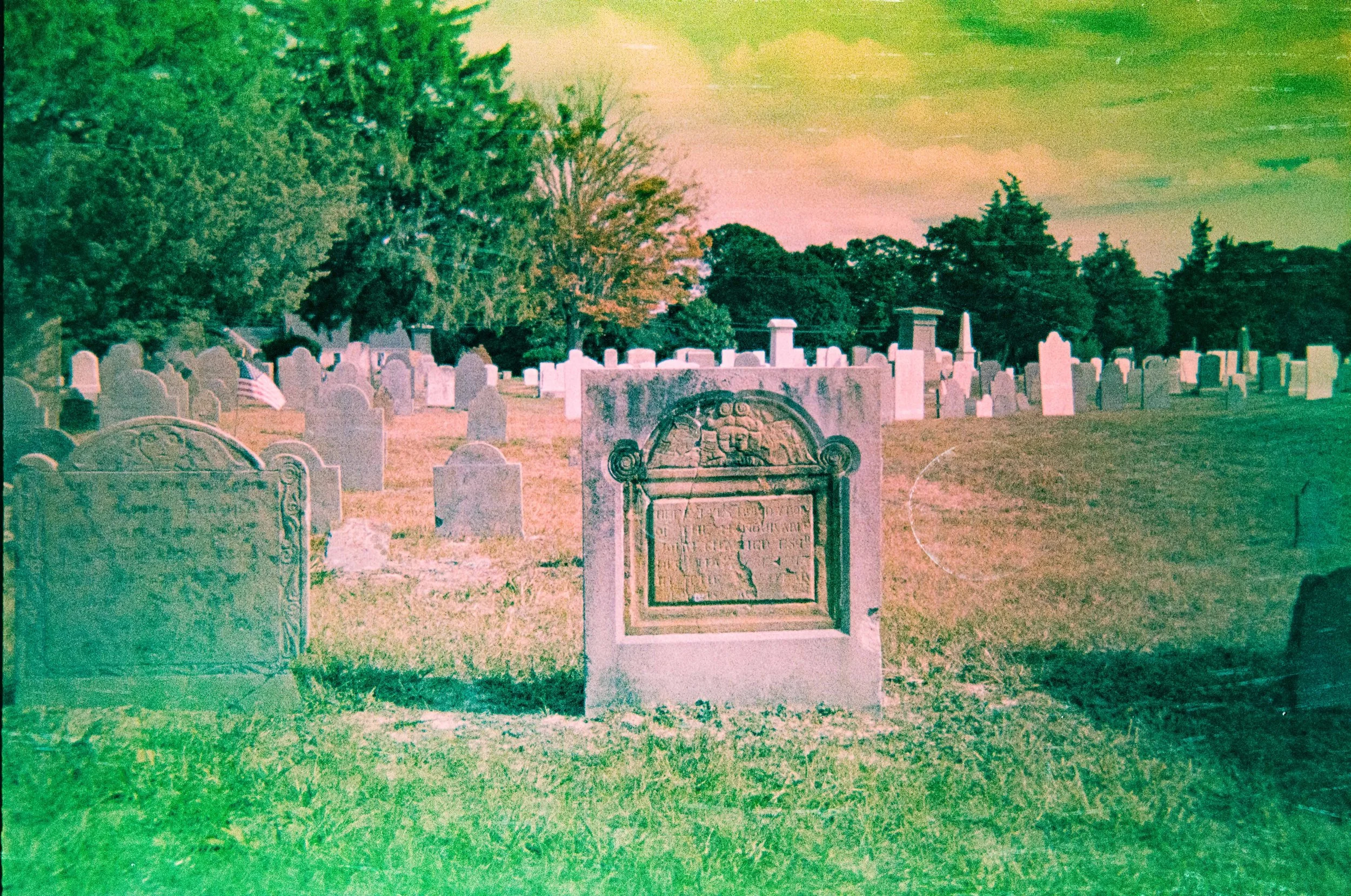
In Eastham, February and March 1816 felt apocalyptic, as the Cold Plague spread voraciously through the town, in just two months nearly 10% of the population of this small, remote town on the coast were lost. No town was hit harder than Eastham, an unassuming sandbar that measures hardly 2.5 miles wide. Bridge Road Cemetery contains many of the victims, with more victims rest underfoot in unmarked graves. The Cold Plague swept slowly through the Outer Cape, a rolling tide of inevitable suffering. By the time the terror ended, 72 people had died in Eastham, in the matter of just four months.
First, it was a dream, then it was an accumulation of signs that she could no longer ignore. There was no doubt that Mercy Hallett felt it coming. Mercy was 17 and the second oldest child of Jeremiah and Beth Hallett, and her mother always warned her to keep her dreams and visions secret. No doubt, the stigma of bearing the same family name as Wellfleet’s famous witch, Maria Hallett, was something that Beth hoped to spare her children from. Jeremiah and Beth had high hopes that their oldest daughter would find a respectable man to marry, hopefully one whose livelihood was on land, not at sea. Mercy knew what was expected of her, and she knew that no one would marry her if they knew her secret.
It had started a year earlier. Early Spring was always a harsh time, cold soaking rains, gray clouds, nor-easters churning on the coast. But early April of 1815 felt different to Mercy, harsher and foreboding than the usual April showers. She took ill, complaining of headache and stomach pain and spent a week in bed, feeling as panicked as she was sick. Every night for a week this horrible nightmare repeated, Mercy was far away, somewhere warm, she could feel the warm breeze on her cheeks. Mercy was on a beach, much too hot in her thick New England petticoat and layers, when she noticed a looming volcano through a canopy of palm trees. Every single night, trapped and paralyzed in her body, Mercy was blinded by a great white light and a deafening boom that knocked her to the warm sand. Then black ash began to fill the skies, erupting from the open mouth of the volcano, she started struggling to breathe, as the ash plumes rose, her chest tightened and the taste of soot was thick in her mouth and nose. On her hands and knees, crawling desperately towards the water, she tried to reach it to clear the ash from her face. Before she could touch her hand out to the calm blue waves lapping, all breath was pulled from her chest and she awoke with a start, noticing strangely, that tears were running down her cheeks. After the sixth night of this, Mercy finally confided in her mother, pulling her close as she told her about her recurring dream. Mercy was insistent, clutching her mother’s sleeve, telling her desperately, “Something bad is coming, I see it every night, we must get ready! We must have our garden ready, we need to store extra food this year.” Beth’s thin lips grew even thinner as heard Mercy’s tale, anxiety was pounding in her stomach, these strange visions of Mercy were the last thing their family needed.
Not another rumor about the Hallett family, even a century on from the death of the Witch of Wellfleet the rumors were still circulating. Beth still felt eyes on her every Sunday at church, she felt her neighbors whispering when they thought she couldn’t hear. Somedays Beth wanted to shake herself and ask why did she marry Jeremiah, why did he have to be the one? She could have married Robert Snow instead; she could have married into a respectable family. But Jeremiah was a romantic, he had courted Beth with hand-picked flowers and even poetry, scribbled by a messy hand. Jeremiah had slowly won Beth over, bringing her fresh apples from his fruit trees, and slowly his surname occupied less space in Beth’s mind and 19 years earlier, she agreed to marry him.
After their marriage, Jeremiah and Beth settled into a small house that he had built for his new bride. Their oldest child, a son named Elijah was born not 6 months when one day Jeremiah came home clearly flustered. Beth hadn’t expected him for a few more hours, and nursing baby Eli she asked her husband what had happened. Jeremiah hesitated, adjusting his collar absentmindedly, not wanting to reveal the truth. Beth insisted, standing up with her babe still in her arms, demanding that Jeremiah tell her what had happened. Finally, he calmed her, guiding her back to her favorite chair, and told her the story he had heard in town, about a strange specter on the dunes.
“Mary Newcomb said that she heard something, last night in Wellfleet on the dunes. She was late returning from her sister’s home in Chatham, but the moon was full and bright and Mary and her brother-in-law thought if they were careful, they could make it safely to Mary’s home in south Wellfleet by horse. With the wind coming off the Bay they were riding on the Ocean, by the dunes, almost to the trail to Mary’s house when they heard a horrible screaming. The horses heard it too, and Mary’s horse reared up, out of the corner of her eye Mary saw a figure in black holding a lantern, looking out to sea. Her brother-in-law, Charles, saw it too, once he had calmed down the horses and they made it to Mary’s house they were frenzied. Mary’s husband Mordecai, tried to calm them, but they were both frantic saying that they had seen the Witch of Wellfleet with her lantern, looking out to the shipwreck where her lover, the pirate Sam Bellamy had drowned and howling a gut-wrenching scream.”
Beth was stunned, the witch of Wellfleet was long dead. No one had reported seeing the Witch’s ghost in years, not since Beth was a small child and still scared by the legends her father and uncles told around the fire. Beth’s father had been initially opposed to her marrying Jeremiah because of the rumors still circulating a century later, but eventually Jeremiah’s insistence and hard-working spirit had won the family over. But now, Beth feared that this sighting would make trouble for her young family. Beth had been born a Mayo, her father a respected church deacon, she had been a good child, quiet, obedient, excellent at needlepoint. But Beth had a secret too, in fact it was from her mother that Mercy inherited her visions…
After her week in bed, Mercy tried to return to her normal life but the nightmare was vivid in her mind and plagued her in moments of quiet rest and boredom. She didn’t mind helping in the garden, but now her help had taken a voracious turn as she begged her father to expand their garden, insisting that they would need extra food this year. Jeremiah finally relented and his brothers came to help cut down a few scrub pines and clear the ground beneath them, using the leftover pinewood to expand the fence that protected the garden. Every morning Mercy had her hands in the soil, gently speaking to the first sprouts, willing them to grow tall and healthy. Mercy never minded the walk down to the beach where she would collect seaweed in her large wicker basket, to bring home and use as manure for the crops. Their garden was full of vegetables and fruits, seeds carried from England on passing ships. The shallow shoals of Cape Cod were a graveyard for ships, and the most useful shipwrecks were the ships carrying seeds and supplies from Europe. Nothing was wasted, every piece of driftwood fashioned quickly onto someone’s home or fence, the pots and pans that came ashore were as good as gold for the housewives. Mercy was collecting seaweed one day, not long after another ship had gone down, far off the last sandbar. She found a small wooden trunk, beaten by the waves and salt but tightly sealed, excited she gathered it in her free hand and nearly ran home to show her family.
Beth and Jeremiah gathered around Mercy and her mysterious trunk in the kitchen, shoulder to shoulder with Elijah and her younger siblings, George, Rachael, Thomas and Eliza. Jeremiah gently pried the smashed brim of the trunk, and with a splinter of wood it came open. Inside were seeds of all kinds, some they had never even seen before; wheat, barley, oat, apple, cotton, asparagus and several varieties of beans and potato seeds. The most precious seeds they pulled out of the trunk were spices and herbs, they had never seen nutmeg before, but the still-dry packages of lavender, wormwood, cayenne pepper, horseradish, thyme, rosemary, sage, rhubarb, and savory were the most valuable. The shores of Outer Cape were often littered with shipwreck debris, but this trunk Mercy had found was very special. Mercy treated these seeds like precious babies, making sure they stayed dry and were kept in the dark until they were ready to be planted. She tended to each seed and slowly nurtured the tiny plants, teaching Rachael and Eliza the medicinal effects she had observed from each herb. Eliza, only 9 years old shared her older sisters knack for brewing soothing teas.
Mercy’s instincts to expand the garden proved fruitful that Autumn as they harvested plant after plant, grinding down corn to store for the winter, drying, canning and preserving whatever they could to store in their root cellar. Even when the cellar’s shelves began to fill, Mercy insistently found space, not allowing her young sibling’s their usual harvest feast. Elijah never had the strange dreams that his sister did, but believed Mercy’s visions, she had always confided in him as they were growing up about her strange dreams. Elijah watched stunned, time and time again as her strange and mundane predictions came true.